
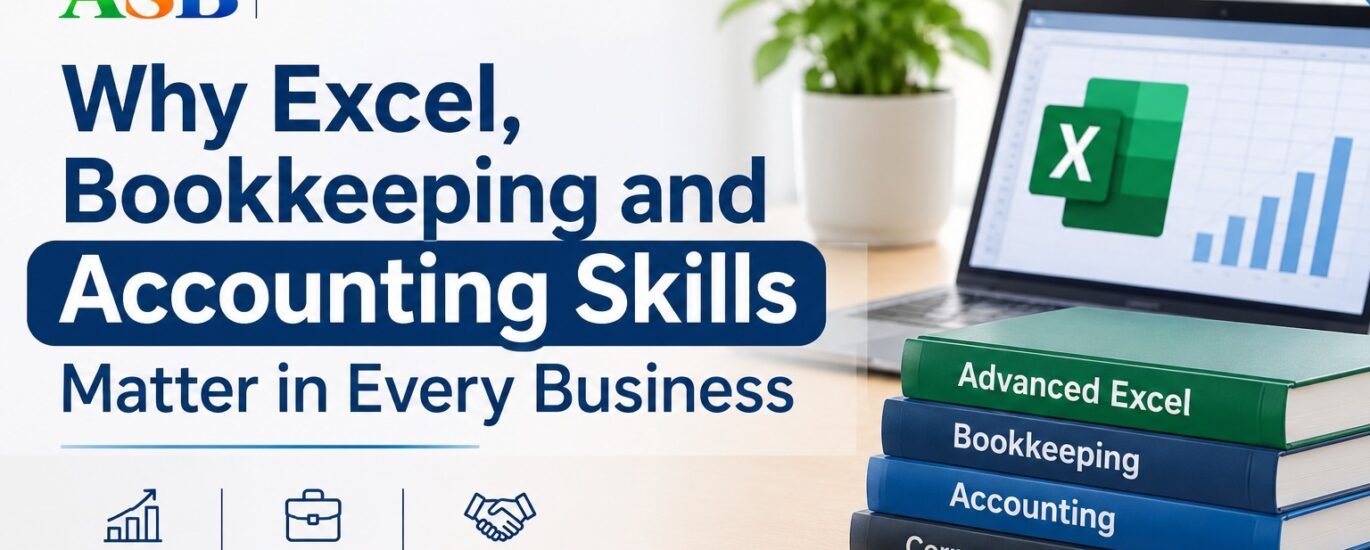
Every business, whether small or large, needs to keep track of its money. From recording daily sales and expenses to managing employee salaries, preparing financial reports and filing taxes, accounting plays an important role in everyday business operations.
This is why companies look for people who understand accounting fundamentals and can handle practical tasks confidently. Knowing how to use Excel, maintain financial records and understand business transactions can make a real difference when applying for an accounts-related job.
If you are planning to enter the accounting field or improve your existing skills, learning Advanced Excel, bookkeeping and practical accounting can be a useful step towards building a stronger career.
Why Are Accounting Skills Important in Every Business?
A business cannot make informed financial decisions without knowing where its money is coming from and where it is going.
Accounting helps businesses maintain records of income, expenses, purchases, sales, outstanding payments and other financial activities. These records also help business owners understand their financial position.
For an accounting professional, this means more than simply entering figures into a computer. You need to understand transactions, maintain accurate records and prepare information that businesses can use.
Good accounting knowledge is useful in several areas, including:
- Recording daily financial transactions.
- Managing sales and purchase entries.
- Tracking payments and outstanding balances.
- Preparing financial statements.
- Maintaining tax-related records.
- Supporting business budgeting and planning.
These are some of the reasons accounting knowledge remains important across different industries.
1. Learn Bookkeeping to Understand the Basics of Accounting
Before moving towards advanced accounting, it is important to understand bookkeeping.
Bookkeeping involves recording and organising the financial transactions of a business. It forms the foundation of the accounting process because financial reports depend on properly maintained records.
If you want to learn bookkeeping, start with basic concepts such as:
- Debit and credit entries.
- Journal and ledger.
- Cash book maintenance.
- Sales and purchase records.
- Bank reconciliation.
- Accounts receivable and payable.
A good book keeping and accounting course should help students understand these concepts through practical examples instead of limiting learning to definitions and theory.
For example, when a business purchases goods on credit, an accounts professional should know how to record the transaction and understand how it affects the company’s accounts.
Understanding these everyday activities makes it easier to handle accounting responsibilities in a workplace.
2. Why Advanced Excel Is Important for Accounting Professionals
Excel is widely used in offices to organise financial information, prepare reports and manage data. Even when businesses use dedicated accounting software, Excel remains a useful tool for many accounting tasks.
Basic Excel knowledge may be enough for simple data entry, but accounting professionals often need more advanced skills to work efficiently.
An Advanced Excel course can help students learn:
- VLOOKUP and XLOOKUP.
- IF and nested IF formulas.
- SUMIF and COUNTIF.
- Pivot Tables and Pivot Charts.
- Data sorting and filtering.
- Conditional formatting.
- Data validation.
- Financial data analysis and reporting.
For example, an accountant may need to prepare a monthly expense report from hundreds of entries. Using Excel formulas and Pivot Tables can make this task easier and reduce the time spent on manual calculations.
Learning Advanced Excel alongside accounting also helps students become more comfortable handling the kind of data they may encounter in an office.
3. What Do You Learn in an Advanced Accounting Class?
Once the basics of bookkeeping are clear, the next step is understanding more detailed accounting activities.
An advanced accounting class should go beyond basic entries and help students understand how different financial activities are managed in a business.
Some important areas include:
- Preparation of final accounts.
- Bank reconciliation statements.
- Depreciation and asset accounting.
- Accounts payable and receivable.
- GST-related accounting entries.
- TDS accounting.
- Financial statement preparation.
- Practical accounting software operations.
These concepts are useful when working in an accounts department, where employees are expected to maintain records, check transactions and assist with financial reporting.
The aim should be to understand why an entry is made, how it affects the accounts and where it appears in financial reports.
4. Understanding Corporate Accounting and Its Role in Businesses
Corporate accounting deals with the financial records and reporting requirements of companies. It involves maintaining accounts, recording business transactions and preparing financial information for management and other stakeholders.
A corporate accounting course can introduce students to areas such as:
- Company financial statements.
- Share capital and reserves.
- Corporate financial transactions.
- Fixed asset accounting.
- Profit and loss statements.
- Balance sheets.
- Financial reporting fundamentals.
These skills are particularly useful for people interested in working with companies, finance departments and accounting firms.
Corporate accounting also helps students understand how financial information is used to assess business performance and support important decisions.
5. Why Practical Accounting Knowledge Matters More Than Theory Alone
Knowing accounting definitions is one thing. Being able to maintain actual business records is another.
Employers often expect new employees to understand everyday accounting work, including entering transactions, preparing reports, checking balances and handling basic documentation.
This is why practical training matters.
During accounting training, students should get opportunities to work on examples based on real business situations, use Excel for calculations and reporting, and understand accounting software.
Combining bookkeeping, Advanced Excel and practical accounting knowledge gives learners a better understanding of how accounts departments operate.
6. What Career Opportunities Can These Skills Open Up?
Learning accounting and Excel can help prepare students for different entry-level and support roles, depending on their knowledge, practical experience and overall qualifications.
Some possible career options include:
- Accounts Assistant.
- Junior Accountant.
- Bookkeeper.
- Billing Executive.
- Accounts Executive.
- MIS Executive.
- Finance and Accounts Assistant.
Students can also strengthen their skills while pursuing further qualifications or gaining work experience.
The important thing is to choose training that matches the type of work you want to do and gives you enough practical exposure to handle everyday responsibilities.
7. Choose the Right Accounting Training in Chandigarh
If you are looking for accounting training, do not choose a course only because it covers several topics. Check what you will actually learn and how the concepts are taught.
Look for a training programme that covers bookkeeping fundamentals, practical accounting, Advanced Excel and relevant corporate accounting concepts.
At ASB Chandigarh (Accounting School of Business), students can explore accounting and finance-related learning with guidance from Mr. Naresh Kumar, who brings over 20 years of experience.
The focus is on helping students understand accounting concepts and develop skills that are useful in professional work.
Frequently Asked Questions
1. Is Advanced Excel useful for accounting jobs?
Yes. Advanced Excel is useful for preparing financial reports, organising accounting data, calculating expenses and analysing business information.
2. Can beginners learn bookkeeping without accounting experience?
Yes. Beginners can start with basic bookkeeping concepts such as debit and credit, journal entries, ledgers and cash book maintenance before moving to advanced topics.
3. What is included in a bookkeeping and accounting course?
A bookkeeping and accounting course generally covers journal entries, ledgers, cash books, bank reconciliation, sales and purchase records, and basic financial reporting.
4. What is the difference between basic and corporate accounting?
Basic accounting focuses on recording and managing everyday financial transactions, while corporate accounting covers company-related financial records, reporting and other corporate financial activities.
5. Should I learn Excel before joining an accounting course?
No. You can learn Excel alongside accounting. In fact, understanding accounting concepts while practising Excel can help you apply both skills more effectively.
Final Thoughts
Every business needs people who can maintain accurate financial records, work with numbers and understand how money moves through the organisation.
Learning bookkeeping gives you a foundation, Advanced Excel helps you manage information efficiently, and accounting knowledge prepares you to handle business transactions and financial records.
If you want to build a career in accounts or improve your existing knowledge, start by developing these practical skills. They can help you become more confident and better prepared for the responsibilities of an accounting role.