
Getting your first accounts job can feel challenging, especially when you have studied accounting but have little experience working with accounting software.
You may understand debit and credit from your commerce classes, but what happens when you need to record a sales transaction, prepare an invoice, maintain a ledger or check a company’s financial records?
This is where practical accounting knowledge and software skills become useful.
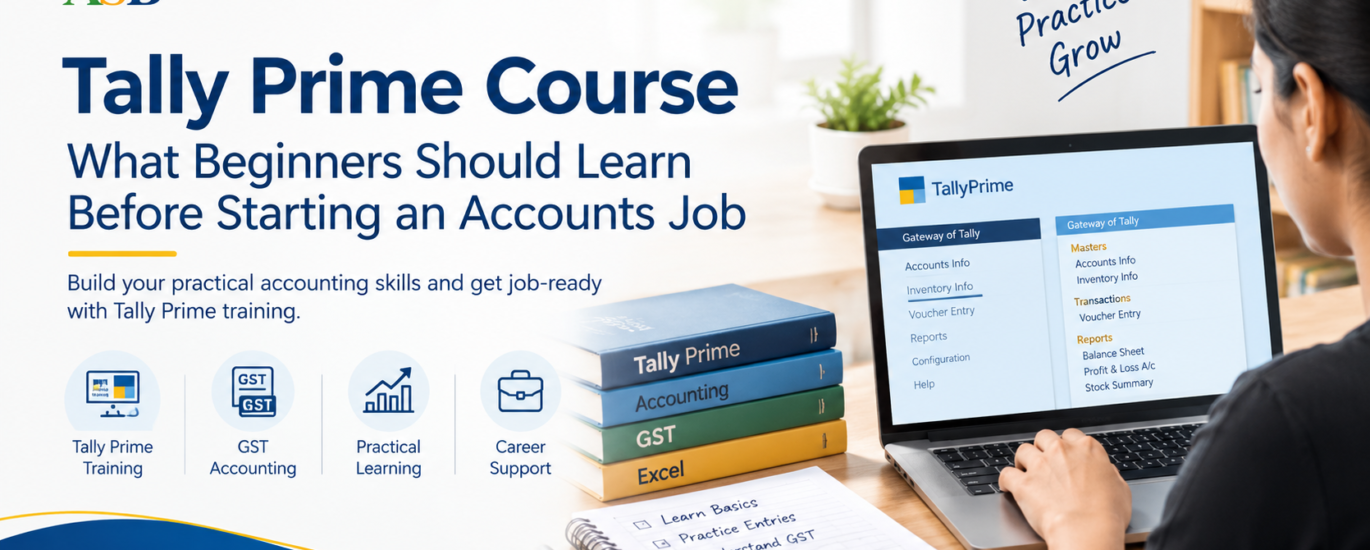
Tally Prime is accounting software that helps businesses manage transactions, maintain financial records, handle inventory and work with GST-related accounting. Learning how to use it can help students and beginners understand how everyday accounting tasks are performed in a business.
If you are considering a Tally Prime course, here is what you should learn before applying for an accounts-related job.
What Is Tally Prime, and Why Is It Useful?
Tally Prime is business management and accounting software used to record financial transactions and organise business information.
Depending on the business and the role, an accountant may use it to record sales and purchases, maintain ledgers, manage payments and receipts, review financial reports and work with inventory records.
For example, imagine a shop selling products to customers every day. The business needs accurate records of its sales, purchases, payments and outstanding amounts. Accounting software helps organise these transactions so that the business can review its financial position.
Learning Tally Prime gives you an opportunity to understand how these tasks are handled in a computerised accounting environment.
It is particularly relevant for commerce students, B.Com graduates, aspiring accounts assistants and people who want to improve their bookkeeping skills.
1. Understand Basic Accounting Before Learning Tally Prime
One common mistake beginners make is trying to learn software features without understanding the accounting concepts behind them.
Tally Prime can help you record transactions, but you still need to know which accounts are involved and how a transaction should be classified.
Start by understanding:
- Debit and credit.
- Journal entries.
- Ledger accounts.
- Trial balance.
- Sales and purchase transactions.
- Cash and bank transactions.
- Accounts receivable and accounts payable.
- Basic financial statements.
For example, when a business receives payment from a customer, you should understand how that transaction affects the cash or bank account and the customer’s outstanding balance.
Once you understand the accounting entry, learning how to record it in Tally Prime becomes easier.
If you are completely new to accounting, consider strengthening these fundamentals before moving on to advanced software features.
2. Learn Company Creation and Basic Configuration
The first practical step in using Tally Prime is understanding how to create and configure a company.
A beginner should learn how to enter the necessary company details, set the financial year, configure relevant features and understand the basic company settings.
You should also become familiar with the interface and learn how to navigate between different sections.
These may seem like simple tasks, but they form the foundation for working with accounting data.
During practice, use a sample business rather than experimenting with confidential or live company records. This gives you room to learn without worrying about affecting actual financial data.
3. Learn How to Create Ledgers and Record Voucher Entries
Ledgers and voucher entries are among the most important parts of computerised accounting.
A ledger represents an account used to organise transactions, while vouchers are used to record different types of accounting activities.
A practical Tally Prime course should help you understand how to create appropriate ledgers and record transactions accurately.
Important voucher types to learn include:
- Payment voucher: For recording payments.
- Receipt voucher: For recording money received.
- Contra voucher: For eligible transactions between cash and bank accounts.
- Sales voucher: For recording sales.
- Purchase voucher: For recording purchases.
- Journal voucher: For recording appropriate journal entries and adjustments.
Consider a simple example: a business purchases office supplies and pays for them through its bank account. You need to understand the transaction, identify the relevant accounts and record it using the appropriate voucher.
Practising different examples helps you develop accuracy and confidence.
4. Learn Sales, Purchase and Invoice Management
In many businesses, accounts-related work involves handling sales and purchase records regularly.
You should learn how to record transactions, understand the information required on invoices and check whether the entries have been recorded correctly.
Depending on the business, this may involve:
- Recording sales and purchase invoices.
- Understanding customer and supplier ledgers.
- Recording credit transactions.
- Tracking outstanding payments.
- Reviewing sales and purchase reports.
- Understanding applicable tax details.
For example, when a business sells goods on credit, the sale needs to be recorded even if the customer has not paid immediately. You should understand how the transaction affects sales and the amount receivable from the customer.
These practical examples help connect accounting theory with everyday business operations.
5. Understand GST Accounting and Billing
GST knowledge can be useful when working with businesses that need to maintain GST-related accounting records.
As part of your learning, understand the basic concepts of GST and how applicable tax details are handled when recording sales and purchase transactions.
A suitable syllabus may cover:
- Basic GST concepts.
- Tax invoices.
- GST-related ledger configuration.
- Recording eligible sales and purchase transactions.
- Understanding input tax credit concepts.
- Reviewing GST-related reports.
- An introduction to return-filing procedures.
The exact process depends on the transaction, business circumstances and applicable tax rules. Beginners should learn to check the relevant details instead of assuming that every transaction receives the same tax treatment.
If you are comparing a Tally and GST course, look for practical examples that demonstrate how accounting entries and tax information work together.
6. Learn Inventory Management if Your Target Job Requires It
Not every accounting job involves inventory, but it can be important in businesses that buy and sell products.
Tally Prime includes inventory-related features that help businesses maintain information about stock items and movements.
Depending on the course syllabus, you may learn how to:
- Create stock items and units of measurement.
- Maintain stock groups and categories.
- Record purchases and sales involving inventory.
- Review stock summaries.
- Understand how inventory transactions relate to accounting records.
Imagine a business purchasing 50 units of a product and later selling 15. The business needs accurate purchase, sales and stock records.
Practising these transactions helps you understand the connection between inventory and business accounts.
7. Learn How to Read Financial Reports
Recording transactions is only part of accounting work. You also need to understand the reports generated from those transactions.
A beginner should become familiar with reports such as:
- Day Book.
- Ledger reports.
- Trial Balance.
- Profit and Loss Account.
- Balance Sheet.
- Cash and bank summaries.
- Outstanding receivables and payables.
You do not need to become an expert in every report immediately. Start by understanding what each report shows and how to check whether the recorded information appears reasonable.
For example, a Profit and Loss Account helps show the business’s income and expenses over a period, while a Balance Sheet presents its assets, liabilities and capital at a particular point in time.
Learning to interpret reports helps you understand why accurate entries matter.
8. Improve Your Excel Skills Alongside Tally Prime
Tally Prime and Microsoft Excel can complement each other in accounting and office work.
While Tally Prime helps manage accounting records, Excel can be useful for organising data, preparing summaries, checking figures and analysing information.
Some useful Excel skills for beginners include:
- Sorting and filtering data.
- SUM and IF formulas.
- SUMIF and SUMIFS.
- VLOOKUP or XLOOKUP.
- PivotTables.
- Conditional formatting.
- Basic spreadsheet formatting.
For example, you may need to organise a list of customer balances, compare figures or prepare a summary from exported accounting data. Excel skills can make these tasks easier.
You do not need to master every advanced function before starting your career. Focus first on the tools that are relevant to the work you want to do.
9. Practise Realistic Accounting Scenarios Before Applying for Jobs
Watching demonstrations can help you understand the software, but practical exercises are what allow you to test your knowledge.
Try practising a complete set of transactions for a sample business.
Your practice exercise could include:
- Creating a sample company.
- Creating the required ledgers.
- Recording opening balances where applicable.
- Entering sales and purchase transactions.
- Recording payments and receipts.
- Entering suitable GST-related transactions.
- Reviewing the Trial Balance and other reports.
- Checking entries and correcting mistakes.
At the end, try explaining what you recorded and why you used each voucher type.
This approach helps you identify gaps in your knowledge and prepare to discuss practical tasks during an interview.
Use fictional business data for practice, and always verify your work before drawing conclusions from reports.
10. What Jobs Can You Explore After Learning Tally Prime?
Tally Prime training may help you prepare for entry-level opportunities where computerised accounting is relevant.
Depending on your qualifications, practical ability and the employer’s requirements, roles to explore may include:
- Accounts assistant.
- Junior accountant.
- Billing executive.
- Bookkeeping assistant.
- Accounts data-entry operator.
- Inventory and accounts assistant.
Employers may also expect knowledge of accounting fundamentals, Excel, GST-related processes, communication and attention to detail.
Completing a course does not guarantee a job. Your ability to perform tasks accurately and explain your work is also important.
Before applying, review job descriptions in your area and identify the skills employers repeatedly request. You can then focus your practice on those requirements.
How to Choose the Right Tally Prime Course
Not every course covers the same material. Before enrolling, compare the syllabus and ask how much time is dedicated to practical exercises.
Here are a few things worth checking.
A clear syllabus: Make sure the course covers the topics you need, from company creation and ledger management to voucher entries and relevant reports.
Practical exercises: Ask whether you will work through sample transactions rather than only watch software demonstrations.
GST coverage: If you want to learn GST-related accounting, check which topics are included and whether the learning material is up to date.
Trainer guidance: Beginners often need help understanding why a particular entry is made. Choose training that gives you an opportunity to ask questions and practise.
Course details: Confirm the duration, fees, batch timings and any additional topics before making a decision.
If you are looking for a Tally course in Chandigarh, compare available options based on your learning needs instead of choosing solely on price or course duration.
Start Building Your Accounting Skills with ASB Chandigarh
Learning Tally Prime is a useful step towards understanding computerised accounting, but the strongest foundation comes from combining software knowledge with accounting fundamentals and regular practice.
Whether you are studying commerce, have completed B.Com or are exploring accounts-related career options, begin with the basics and gradually work towards more complex transactions and reports.
At Accounting School of Business (ASB Chandigarh), you can enquire about available accounting training options and discuss your learning goals with Mr. Naresh Kumar, who has over 20 years of teaching experience.
Visit ASB Chandigarh to learn more about the institute and enquire about relevant training options.
Before choosing a course, ask yourself one question: Will I be able to record and understand everyday business transactions confidently after completing my training?
That is a useful goal to keep in mind as you build your practical accounting skills.