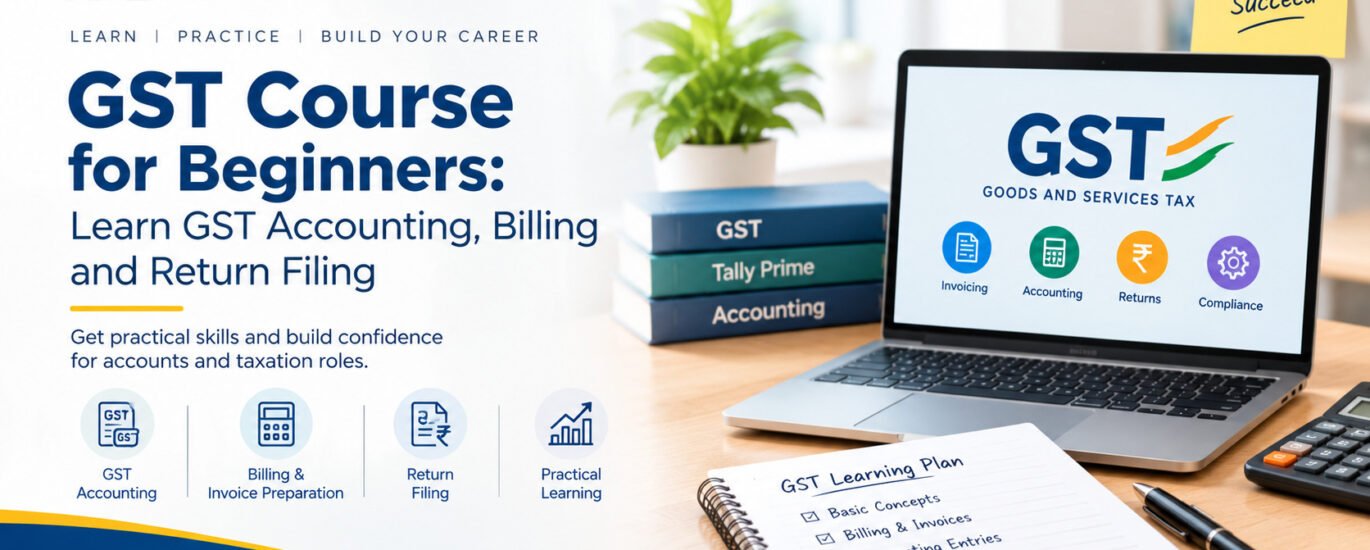
If you have studied commerce or want to build a career in accounting, understanding GST can be a valuable addition to your skills. Businesses regularly deal with invoices, sales and purchase records, tax calculations and compliance-related documentation. Knowing how these tasks work can help you understand the practical side of accounting.
However, GST can feel confusing when you are learning it for the first time. You may have questions about tax invoices, input tax credit, GST entries in accounting software and how returns are prepared.
A structured GST course can help you understand these concepts step by step and see how they are used in everyday business situations.
Whether you are a student, a B.Com graduate or someone looking to improve your accounting knowledge, this guide explains what you should learn before choosing GST training.
What Is GST and Why Should You Learn It?
Goods and Services Tax (GST) is an indirect tax system in India that applies to eligible supplies of goods and services under the relevant provisions of the law.
For businesses, GST involves more than calculating tax on an invoice. Depending on the nature of their transactions and registration requirements, they may also need to maintain accurate records, review purchase and sales information, understand eligible input tax credit and meet applicable return-filing obligations.
For example, a business selling goods needs to record its sales correctly and maintain the information required for its accounting and tax records. Purchase transactions also need to be documented properly so that relevant details can be checked when preparing returns.
Learning GST helps you understand how these activities connect with accounting.
Who Should Consider a GST Course?
GST training can be useful for people at different stages of their education or career.
You may benefit from learning GST if you are:
- A Class 12 commerce student exploring accounting as a career option.
- A B.Com or BBA student who wants practical knowledge beyond classroom learning.
- A fresh graduate preparing for entry-level accounts roles.
- Someone who already knows basic accounting but wants to understand taxation.
- A bookkeeping or accounts professional looking to improve existing skills.
- A learner interested in Tally Prime and GST-related accounting tasks.
You do not need to know every GST rule before beginning. If you are new to accounting, start with the fundamentals and gradually move towards practical examples.
1. Understand the Basic Concepts of GST
Before learning billing or return filing, it is important to understand how GST works.
A beginner’s GST course should introduce the main concepts in clear, simple language.
These may include:
- The meaning and purpose of GST.
- The difference between CGST, SGST and IGST.
- Taxable, exempt and nil-rated supplies.
- Basic concepts of GST registration.
- Taxable value and applicable tax rates.
- Tax invoices and supporting records.
- An introduction to input tax credit.
For example, a supply within the same state may involve CGST and SGST, while an eligible interstate supply may involve IGST. The correct treatment depends on the transaction and applicable GST rules.
Understanding these fundamentals makes it easier to learn how GST is recorded in accounting software and reported through the relevant processes.
2. Learn GST Billing and Invoice Preparation
Billing is one of the practical areas beginners should understand.
A tax invoice contains important information about a transaction, such as supplier and recipient details where applicable, invoice particulars, description of goods or services, taxable value and relevant tax information.
During GST training, you should learn how to understand invoice fields and check whether the information entered is consistent with the transaction.
Practical exercises may include:
- Preparing sample sales invoices.
- Understanding purchase invoices.
- Identifying the applicable GST treatment in example transactions.
- Recording invoice details accurately.
- Understanding credit notes and debit notes.
- Checking invoice information before recording it in accounts.
Imagine a business selling goods to another business. Before recording the sale, you need to understand the transaction, check the invoice details and apply the appropriate tax treatment.
These exercises help you build accuracy and understand why proper documentation matters.
3. Learn GST Accounting Entries in Tally Prime
GST knowledge becomes more useful when you understand how tax-related transactions are recorded in accounting software.
Tally Prime is commonly used for computerised accounting and includes features for recording transactions and handling GST-related accounting, subject to the appropriate configuration.
A practical GST accounting course may cover:
- Creating the necessary ledgers.
- Configuring relevant GST details.
- Recording sales and purchase vouchers.
- Entering eligible tax-related transactions.
- Reviewing accounting entries.
- Checking GST-related reports.
- Understanding how transaction data supports return preparation.
For instance, when a business records a sale, the accounting entry must reflect the transaction and the applicable tax treatment. Learning to review the entry helps you understand the relationship between billing, accounting and GST records.
If you are comparing a Tally and GST course, check whether it includes hands-on practice rather than only theoretical explanations.
4. Understand Input Tax Credit
Input tax credit, commonly called ITC, is an important concept in GST.
In general, eligible registered businesses may be able to claim credit for qualifying GST paid on purchases used for business purposes, subject to the applicable legal conditions and restrictions.
However, not every purchase automatically qualifies for credit.
A learner should understand the importance of checking purchase records, relevant invoice details, applicable eligibility conditions and the information available through the GST system.
For example, when a business purchases goods for resale, the accountant needs to review the transaction and determine whether the related tax credit is eligible under the applicable provisions.
Learning the concept through practical examples helps you avoid treating every purchase as automatically eligible for ITC.
5. Learn the Basics of GST Return Filing
Return filing is another important area of GST training.
GST returns and statements are used to report relevant transaction and tax information. The forms required and the applicable filing frequency depend on the taxpayer’s registration category, activities and other relevant conditions.
Two important forms beginners commonly encounter are:
GSTR-1: Generally used by regular taxpayers to report details of outward supplies, subject to the applicable rules and exceptions.
GSTR-3B: A summary return used by applicable taxpayers to declare relevant tax liabilities and claim eligible input tax credit.
A beginner should understand what these forms are used for, how accounting records support the information reported and why accuracy matters.
Practical learning may include:
- Organising sales and purchase information.
- Reviewing invoice details.
- Understanding the relationship between accounting reports and return data.
- Learning the general return-preparation workflow.
- Reviewing summaries before filing.
- Understanding the importance of applicable due dates.
The exact forms, requirements and filing procedures can vary. GST rules and portal processes may also change, so training should use current official guidance.
For the official process, refer to the GST Portal’s GSTR-1 guide.
6. Understand How GST Reports Help in Accounting
GST-related reports help businesses and accountants review transaction information and identify discrepancies that may need attention.
During practical training, you should learn how to examine relevant reports and compare the information with the underlying accounting records.
For example, if the sales recorded in the books do not match the information being prepared for a return, the difference should be investigated before proceeding.
This may involve checking invoices, entries, amendments or other transaction details.
Developing the habit of reviewing figures carefully is an important part of accounting work. It can help you identify errors early and maintain better records.
7. Learn Common GST Mistakes and How to Avoid Them
Beginners often make mistakes when they are unfamiliar with tax concepts or rush through data entry.
Some common areas requiring attention include:
Incorrect invoice details: Errors in invoice numbers, dates or other particulars can create problems during reconciliation and reporting.
Wrong tax treatment: GST should not be applied using assumptions alone. The nature of the supply and applicable rules need to be considered.
Incomplete records: Missing purchase invoices or sales information can make it harder to prepare accurate reports.
Incorrect accounting entries: A transaction recorded under the wrong ledger can affect financial reports and tax-related information.
Skipping reconciliation: Comparing relevant records and investigating differences can help identify issues before filing.
A practical GST course should give learners opportunities to work through sample transactions, identify mistakes and understand how to correct them appropriately.
8. What Skills Can You Develop Through GST Training?
A good course should help you develop more than theoretical knowledge.
Depending on the syllabus and the amount of practical work involved, you may improve your ability to:
- Understand basic GST concepts.
- Read and check invoices.
- Record sales and purchase transactions.
- Work with GST-related accounting entries.
- Use relevant accounting software features.
- Understand the purpose of GST returns.
- Review transaction data and supporting records.
- Identify discrepancies that need further checking.
These skills can complement your existing accounting knowledge and help you prepare for work involving billing, bookkeeping or accounts support.
The actual skills you develop will depend on the course content, your practice and your previous experience.
9. What Jobs Can You Explore After GST Training?
GST knowledge can be useful in several accounting and business-support roles, depending on your qualifications and experience.
Possible roles to explore include:
- Accounts assistant.
- Junior accountant.
- Billing executive.
- Bookkeeping assistant.
- GST documentation assistant.
- Accounts and taxation support staff.
Employers may also expect knowledge of accounting fundamentals, Tally Prime or other accounting software, Excel and general office procedures.
Completing a GST course does not guarantee employment. However, combining GST knowledge with practical accounting exercises can help you understand the tasks associated with these roles.
If you are preparing for interviews, practise explaining how you would record a transaction, check an invoice and review relevant accounting information.
10. How to Choose the Right GST Course in Chandigarh
If you are looking for a GST course in Chandigarh, compare institutes based on the training you will actually receive.
Here are a few things worth checking before enrolling.
Practical learning: Ask whether the course includes invoice preparation, accounting entries, sample transactions and GST-related reports.
Relevant syllabus: Check whether the topics match your learning goals, especially if you want to understand GST accounting and return preparation.
Accounting software: If you also want to learn Tally Prime, ask whether software-based GST practice is included.
Trainer guidance: Beginners often need help understanding why a particular entry or tax treatment is used. Look for an opportunity to ask questions and practise.
Updated material: GST provisions and filing processes can change. Confirm that the training uses relevant learning materials and current official references.
Clear course details: Before enrolling, ask about the duration, fees, batch timings and subjects covered.
Choosing a course based on these factors can help you make a more informed decision.
Start Learning Practical GST Accounting with ASB Chandigarh
Understanding GST is easier when you connect the concepts with actual accounting tasks. Start with the fundamentals, practise billing and accounting entries, learn how relevant records support return preparation, and gradually build confidence with more complex examples.
If you are exploring accounting training, ASB Chandigarh is a place to enquire about available courses and practical learning options.
You can also discuss your learning goals with Mr. Naresh Kumar, who has over 20 years of teaching experience, to understand which available training option may suit your current level.
Visit ASB Chandigarh to learn more about the institute and enquire about relevant courses.
The best way to begin is to focus on understanding the process, not just memorising GST terms. When you know how invoices, accounting entries and return information fit together, you have a stronger foundation for learning practical accounting.