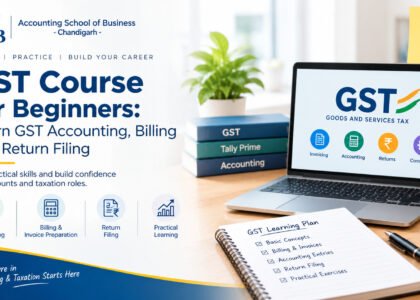
If you are planning to build a career in accounting or want to understand how businesses manage their taxes, learning GST is a useful place to start. GST is an important part of everyday business operations in India, from preparing invoices to maintaining sales records and filing returns.
For students, freshers, and anyone interested in accounting, understanding GST can make it easier to handle practical accounts-related work. However, reading about GST is not always enough. You also need to understand how it works in real business situations.
At ASB Chandigarh, learning the basics of GST accounting and return filing can help you develop the knowledge needed to approach accounting tasks with greater confidence.
What Is GST and Why Is It Important?
GST stands for Goods and Services Tax. It is an indirect tax charged on the supply of goods and services in India. It brought several earlier indirect taxes under a common tax framework.
Businesses need to maintain proper records of their sales, purchases, and applicable taxes. Depending on their registration, business activities, and legal requirements, they may also need to issue GST-compliant invoices and file GST returns.
For example, when a registered business sells goods to a customer, the invoice may include GST at the applicable rate. The business must record the transaction correctly and account for the tax according to the relevant rules.
This is why GST knowledge is useful for accountants, billing executives, accounts assistants, and people who want to work in finance or taxation.
Who Should Learn GST Accounting?
A GST course for beginners can be useful for people who want to understand taxation and improve their practical accounting knowledge.
1. Commerce students: Students studying commerce can learn how GST concepts apply to everyday business transactions.
2. Freshers looking for accounting jobs: If you want to apply for an accounts assistant, billing executive, or junior accountant position, GST knowledge can be a useful addition to your skills.
3. Working professionals: People already working in accounts may want to strengthen their understanding of GST entries, invoices, and return filing procedures.
4. Business owners: Small business owners can benefit from understanding GST documentation and compliance requirements, even when a professional handles their tax filings.
5. Beginners interested in taxation: You do not necessarily need extensive work experience to begin learning GST. Starting with the basics and practising examples can help you build a foundation.
What Will You Learn in a GST Course?
A practical GST training programme should cover the concepts and tasks that learners are likely to encounter in accounting work. The exact syllabus depends on the course, but these are some important areas to understand.
1. Basics of GST
Start by understanding how GST works, why it is charged, and how it applies to the supply of goods and services. You should also become familiar with concepts such as taxable supplies, input tax credit, and GST registration.
2. GST Billing and Invoice Preparation
GST invoices are an important part of business accounting. Learn the essential invoice details, how taxable values are calculated, and how the applicable GST is recorded.
For example, if the taxable value of a product is ₹10,000 and the applicable GST rate is 18%, the GST amount would be ₹1,800. The total invoice value would be ₹11,800, assuming no other charges or adjustments.
Understanding such calculations helps beginners become more comfortable with billing and accounting entries.
3. Input Tax Credit (ITC)
Input tax credit allows eligible registered businesses to claim credit for GST paid on qualifying business purchases, subject to the applicable conditions and restrictions.
Learning how ITC works helps you understand purchase records, tax calculations, and the importance of maintaining accurate documentation.
4. GST Entries in Accounting Software
Knowing the theory is helpful, but accounting work also involves recording transactions correctly.
Practical exercises can help you understand how sales, purchases, expenses, and GST amounts are entered into accounting software such as Tally Prime. You can also learn how to review transaction records and identify common entry mistakes.
5. GST Return Filing
GST return filing involves reporting relevant business and tax information to the tax authorities in the prescribed format and within the applicable deadlines.
Beginners should understand the purpose of common returns, including:
- GSTR-1: Generally used to report details of outward supplies.
- GSTR-3B: A summary return used to declare relevant tax liabilities and discharge them, subject to applicable rules.
The information reported in these returns should be supported by accurate records. Practical training can help learners understand the process, the information required, and the importance of checking details before submission.
Actual filing obligations and deadlines depend on the taxpayer’s circumstances and current GST rules.
Why Is Practical GST Training Important?
Imagine joining an office where you are asked to prepare a GST invoice, enter a purchase transaction, check a sales register, or help organise information for a GST return.
If you have only studied definitions, these tasks may feel unfamiliar at first. When you have worked through similar examples during training, you have a clearer idea of what to do and which details need attention.
Practical accounting courses help connect classroom learning with everyday office responsibilities. By working with sample transactions, invoices, ledgers, and reports, learners can improve their accuracy and become more familiar with accounting procedures.
Combining GST knowledge with Tally Prime and basic accounting skills can also help you build a broader foundation for entry-level accounting work.
Career Opportunities After Learning GST
GST knowledge can be relevant to several accounting and finance-related roles, depending on your overall skills, qualifications, and experience.
Some possible roles include:
- Accounts assistant
- Junior accountant
- Billing executive
- GST assistant
- Taxation assistant
- Accounts executive
Employers may also look for knowledge of bookkeeping, spreadsheets, bank reconciliation, TDS, income tax, and other accounting procedures. Learning GST is therefore best viewed as one part of developing practical accounting skills rather than a guarantee of employment.
Why Choose ASB Chandigarh for Accounting Training?
When choosing a GST course, look beyond the course title. Consider whether the training explains concepts clearly, includes practical exercises, and helps you understand how accounting tasks are performed in a business.
ASB Chandigarh offers an opportunity for learners to explore accounting and finance training relevant to their career interests. Before enrolling, ask about the GST syllabus, practical work, software coverage, and whether return filing procedures are included in the course.
If you are new to accounting, a structured learning approach can help you progress from basic concepts to more practical tasks at a manageable pace.
Start Learning GST Accounting Today
GST is an important part of modern business accounting, and understanding it can help you prepare for further learning in taxation and finance. Whether you are a student, a fresher, or someone looking to improve your existing skills, begin with the basics and spend time practising real-world examples.
Explore the accounting training options at ASB Chandigarh to learn more about developing your knowledge of GST, accounting software, and return filing.
Visit asbchandigarh.com to explore the available courses and find a suitable next step for your learning journey.
Frequently Asked Questions (FAQs)
1. Can beginners learn GST accounting?
Yes. Beginners can start with basic accounting concepts, GST calculations, invoice preparation, and simple transaction examples before moving on to return filing.
2. What is included in GST training?
Depending on the course, GST training may cover GST fundamentals, billing, purchase and sales entries, input tax credit, accounting software, and GST return filing procedures.
3. Is Tally Prime useful for GST accounting?
Yes. Tally Prime can help businesses record GST-related transactions, prepare invoices, maintain accounts, and generate relevant reports when configured correctly.
4. What is the difference between GSTR-1 and GSTR-3B?
GSTR-1 generally reports details of outward supplies, while GSTR-3B is a summary return used to declare relevant tax liabilities and pay tax. Their requirements depend on the applicable rules and taxpayer category.
5. Can learning GST help me get an accounting job?
GST knowledge can support applications for entry-level accounting, billing, and taxation roles. Practical experience, general accounting knowledge, software skills, and other qualifications are also important.