Choosing the right course after Class 12, graduation or B.Com can be confusing. You may want to start working, improve your accounting knowledge or learn a practical skill that helps you apply for accounts-related jobs. But with so many courses available, how do you decide which one is right for you?
If you are exploring accounting courses in Chandigarh, it helps to understand what each course teaches, who should consider it and how the skills can be used in a real working environment.
Accounting is not limited to recording transactions in books. Businesses also need people who can manage financial records, prepare invoices, work with accounting software, understand GST-related processes and organise financial data using Excel.
The right training can help you develop these skills step by step.
Why Should You Consider Learning Practical Accounting?
Commerce students study accounting as part of their education, but working with actual business records can be quite different from solving questions in an examination.
For example, an accountant may need to record sales and purchase transactions, maintain ledgers, prepare invoices, reconcile bank statements and organise financial reports. Depending on the role, the work may also involve accounting software, spreadsheets and taxation-related processes.
Learning practical accounting helps you understand how these tasks are performed.
It can be particularly useful if you are:
- A Class 12 commerce student exploring career options.
- A B.Com or BBA student who wants to develop additional skills.
- A graduate looking for entry-level accounts roles.
- Someone who wants to improve existing bookkeeping or accounting knowledge.
- A working professional who wants to become more comfortable with accounting software and Excel.
You do not necessarily need to learn everything at once. Start by identifying your current knowledge and the type of work you would like to do.
Which Accounting Course Is Right for You?
There is no single course that suits everyone. Your choice should depend on your educational background, existing skills and career goals.
1. Basic Accounting and Bookkeeping
If you are new to accounting, start with the fundamentals.
A basic accounting course helps you understand how business transactions are recorded and how financial information is organised. These concepts also make it easier to learn accounting software later.
Topics worth learning include:
- Debit and credit.
- Journal entries and ledger accounts.
- Trial balance.
- Sales and purchase transactions.
- Cash and bank transactions.
- Basic financial statements.
- Accounts receivable and accounts payable.
Who should consider it?
Beginners, students who need to strengthen their accounting fundamentals and people who want to understand bookkeeping before moving to software-based accounting.
2. Tally Prime Course
Tally Prime is accounting software used by businesses for recording transactions and managing various accounting activities.
A Tally course can help you understand how accounting concepts are applied using software rather than only on paper.
Depending on the syllabus, training may cover company creation, ledger management, voucher entries, sales and purchase transactions, inventory, GST-related entries and financial reports.
For example, when a business sells products to a customer, the transaction needs to be recorded correctly. Learning how to enter the transaction and review the resulting reports helps you understand the accounting process more clearly.
Who should consider it?
Commerce students, B.Com graduates, beginners interested in bookkeeping and people who want to develop computerised accounting skills.
When comparing a Tally course in Chandigarh, look for opportunities to practise actual accounting scenarios instead of learning only the software’s menus and features.
3. GST Course
GST knowledge can be useful for people who want to work in accounting, bookkeeping or tax-related support roles.
A GST course introduces learners to the basic concepts of Goods and Services Tax and how GST information is handled in business records.
Depending on the course, the syllabus may include:
- GST fundamentals.
- Tax invoices and billing.
- Input tax credit concepts.
- GST entries in accounting software.
- Understanding GST reports.
- An introduction to return-filing procedures.
GST rules and procedures can change, so it is important to learn from updated materials and understand the difference between basic training and professional tax advice.
Who should consider it?
Students who already understand basic accounting, aspiring accountants and learners who want to build their knowledge of business taxation.
If you are comparing a GST course in Chandigarh, check whether the training includes practical examples and updated learning material.
4. Advanced Excel Course
Excel is useful in many office roles, including accounting, administration, finance and data management.
For accounting work, it can help you organise transactions, compare figures, prepare summaries and analyse large amounts of data more efficiently.
Important skills to learn include:
- SUMIF and SUMIFS.
- IF and other logical functions.
- VLOOKUP or XLOOKUP.
- Sorting and filtering.
- PivotTables.
- Conditional formatting.
- Data validation.
- Basic charts and reports.
Imagine receiving a spreadsheet containing hundreds of sales transactions. Instead of checking every row manually, you can use formulas and PivotTables to summarise the information and identify patterns.
Who should consider it?
Students, job seekers, accountants and professionals who want to improve their spreadsheet skills.
When choosing an Advanced Excel course, look for practical exercises involving business data rather than focusing only on memorising formulas.
5. Payroll and Taxation Training
Payroll involves maintaining employee salary information and preparing payroll-related records. Taxation training can introduce learners to concepts such as TDS and income tax procedures.
The exact syllabus varies by institute and course level, so check what is covered before enrolling.
These subjects can complement accounting knowledge, especially for learners interested in accounts departments, payroll administration or taxation support.
Who should consider it?
Learners who already have a basic understanding of accounting and want to explore more specialised office responsibilities.
Which Course Should You Choose After B.Com?
If you have completed B.Com, the best course depends on what you already know and the type of role you want to pursue.
Here is a simple way to think about your options.
| Your current situation | Skills worth considering |
|---|---|
| You understand accounting theory but lack practical experience | Practical accounting and bookkeeping |
| You have never used accounting software | Tally Prime and computerised accounting |
| You want to understand business taxation | GST and taxation fundamentals |
| You struggle with spreadsheets and financial data | Advanced Excel |
| You want to build broader accounts-related skills | Accounting, Tally Prime, GST and Excel |
You may not need separate training in every subject. Some programmes combine accounting fundamentals, software training and taxation concepts.
Before selecting a course, compare the syllabus and check how much practical work is included.
What Should You Look for in Accounting Classes in Chandigarh?
Choosing an institute involves more than comparing course names. The quality of training and the way concepts are explained can make a real difference to your learning experience.
Here are a few things worth checking.
A Practical Learning Approach
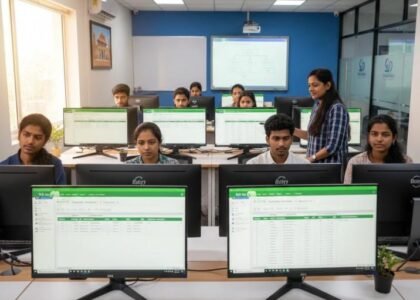
Ask whether you will practise accounting entries, prepare invoices, maintain ledgers and work with sample business transactions.
Practical exercises help you understand how the concepts are used outside the classroom.
A Clear and Relevant Syllabus
Make sure you know which subjects are included. If you are interested in Tally Prime, check whether the programme covers accounting fundamentals as well as software operations.
For Excel, look for exercises using formulas, reports and business data.
Guidance for Beginners
If you have limited accounting knowledge, you may benefit from a teaching approach that explains the basics before moving to advanced topics.
Do not hesitate to ask how the trainer supports students when they find a concept difficult.
An Experienced Trainer
An experienced teacher can often explain concepts through examples drawn from everyday business situations.
At ASB Chandigarh, students can enquire about the available accounting training options and discuss their learning needs with Mr. Naresh Kumar, who has over 20 years of teaching experience.
Before enrolling, ask about the current syllabus, course duration, fees and the practical exercises included.
Can an Accounting Course Help You Get a Job?
Learning accounting skills can help you prepare for entry-level opportunities, depending on your knowledge, practical ability and other qualifications.
Potential roles to explore include:
- Accounts assistant.
- Junior accountant.
- Bookkeeping assistant.
- Billing executive.
- Accounts data-entry operator.
- Payroll assistant, where relevant skills are required.
Employers may look for a combination of accounting fundamentals, software knowledge, Excel skills, attention to detail and communication abilities.
Completing a course does not guarantee employment. However, practising realistic tasks and being able to explain your work can help you prepare for interviews and workplace responsibilities.
Alongside your training, practise recording transactions, checking invoices, preparing spreadsheets and explaining the accounting process in your own words.
How to Get Started If You Are a Complete Beginner
If you are unsure where to begin, follow a simple learning path.
Step 1: Understand accounting basics. Learn debit, credit, journal entries, ledgers and the purpose of financial statements.
Step 2: Practise computerised accounting. Once you understand the fundamentals, learn how transactions are recorded in accounting software such as Tally Prime.
Step 3: Develop your GST knowledge. Understand the basic concepts and how tax-related information appears in invoices and accounting records.
Step 4: Improve your Excel skills. Practise formulas, data organisation and reports using sample business transactions.
Step 5: Work on practical exercises. Try completing a small accounting assignment from beginning to end. Review your entries and identify mistakes.
You can adjust this sequence based on your existing knowledge. If you already use Tally Prime, for example, it may be more useful to improve your Excel or GST skills.
Find the Right Accounting Course for Your Goals
The best accounting course is not necessarily the one with the longest syllabus. It is the one that matches your current level, teaches relevant skills and gives you enough practice to understand what you are learning.
Whether you are a commerce student, a B.Com graduate or someone looking to improve your accounting knowledge, begin by identifying the skills you need most.
ASB Chandigarh can be a starting point for exploring suitable accounting training options. Contact the institute to discuss your goals, understand the available courses and find out which programme fits your learning requirements.
Ready to take the next step? Visit ASB Chandigarh to learn more about the institute and enquire about available accounting training options.
A little clarity at the beginning can help you choose your course more confidently and make better use of your learning time.