Type “accounting courses in Chandigarh” into Google and you will see dozens of options. Some promise placement. Some promise a certificate in 30 days. Very few tell you what you will actually be able to do on your first day at work.
That is the question that matters. Employers in Chandigarh, Mohali and Panchkula do not hire on certificates alone. They hire people who can open the software, pass entries, file a return and fix a mistake without waiting for someone to help. This guide breaks down the skills that really get freshers hired, so you can pick a course that is worth your time and money.
What Do Employers Look for in a Fresher Accountant?
Talk to any business owner or CA firm and the answer is surprisingly similar. They want someone who can handle the daily work of a real office: recording sales and purchases, tracking stock, preparing GST returns, deducting TDS and keeping the books ready for the auditor.
A degree helps, but it rarely covers all of this. That gap between college theory and office reality is where a good practical accounting course earns its value. Below are the six skills that fill that gap.
1. Tally Prime: The Software Most Offices Rely On
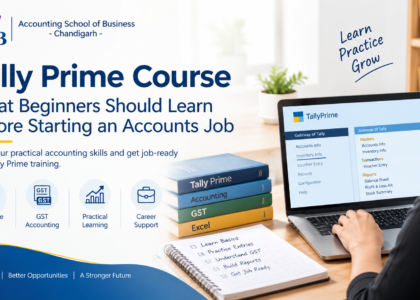
Ask a small business or CA firm which accounting software they use, and Tally Prime is the most common answer. It handles ledgers, vouchers, invoices, bank entries and reports in one place.
A strong Tally Prime course should go beyond basic voucher entry. Look for training in inventory and stock management, GST-ready billing, bank reconciliation and reports like the balance sheet and profit and loss account. If a course only teaches you to click through menus without explaining why an entry is made, you will struggle the moment a real situation looks different.
2. GST: Needed in Almost Every Accounts Job
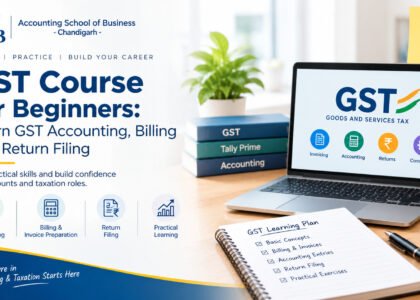
Any business that sells goods or services deals with GST, which makes it one of the most requested skills in job listings. You should understand how to raise a proper GST invoice, how input tax credit works, and how monthly and annual returns such as GSTR-1 and GSTR-3B are filed.
Keep your learning current, too. In September 2025 the government rolled out GST 2.0, which simplified most rates into two main slabs of 5% and 18%. A course that still teaches the old rate structure is a red flag.
3. TDS: Where Small Mistakes Become Expensive
TDS means tax deducted at source. Businesses deduct it on salaries, rent, professional fees and other payments, then deposit it with the government and file quarterly returns. Errors can lead to notices, interest and late fees.
An accountant who knows which payments attract TDS, at what rate, and when to deposit and file is valuable because they save the employer from costly mistakes. Many freshers skip this topic, which makes it a real advantage if you learn it well.
4. Income Tax and ITR Filing: Now Under a New Law
From 1 April 2026, the Income-tax Act, 2025 replaced the old 1961 law. The biggest everyday change is the new term “Tax Year”, which replaces the confusing pair of “Previous Year” and “Assessment Year”. Tax slabs for individuals were not changed by the new Act.
Knowing how to file an ITR for salaried people, small traders and professionals is a skill you can use in a job or as extra income during filing season. Check that your course covers the new terminology, the different ITR forms and how to respond to common notices.
5. Advanced Excel: The Skill That Sets You Apart
Even with accounting software, a lot of real analysis happens in Excel. Formulas like VLOOKUP or XLOOKUP, pivot tables and simple dashboards help you reconcile data, prepare reports for management and spot errors faster. Employers notice freshers who can turn raw data into a clear report without being asked.
6. Bookkeeping and Payroll: The Foundation
Everything above rests on bookkeeping basics: debit and credit, journal entries, ledgers and the trial balance. Payroll is the other everyday task, covering salary calculation, PF, ESI and payslips. Together they form the core of most entry-level accounts roles, and they are usually where a new hire is first given responsibility.
Why Practical Training Beats Theory-Only Classes
Reading about a GST return and filing one are two very different experiences. Courses that use real business transactions, live software and actual return-filing exercises teach you how to handle problems, not just recall definitions.
Here is a simple test. Ask the institute whether you will work on live practice entries and return filing, or only watch demonstrations. Learning by doing builds the confidence you need in interviews, where you may be asked to complete a short practical task on the spot.
How to Choose the Best Accounting Course in Chandigarh
Before you pay any fee, run through this checklist:
- Does the syllabus cover Tally Prime, GST, TDS, ITR and Excel together?
- Is the trainer a working professional with real industry experience?
- Will you practise on real-style business cases, not just notes?
- Are batches small enough for you to ask questions?
- Is there help with your resume, interview preparation and job leads?
- Is the content updated for the latest GST and income tax changes?
- Can you attend a demo class before you commit?
Be careful with promises of guaranteed jobs. A good institute helps you become employable, and your skills do the rest.
Do You Need a Commerce Background?
No. Many successful accountants started with arts, science or even a long career gap. A well-designed course begins with the basics and builds step by step. What matters more is regular practice and curiosity. If you are a graduate, a career switcher or a homemaker returning to work, accounting is one of the few fields where practical skills can open doors without years of extra study.
Where Can You Learn These Skills in Chandigarh?
If you want training that covers this full skill set, ASB (Accounting School of Business) in Sector 34A, Chandigarh runs job-oriented programs in Tally Prime with inventory, bookkeeping and practical accounting, GST, TDS, ITR filing, payroll and Advanced Excel. Sessions are led by an experienced CA with over 20 years in the field, and students get support with resumes and interview preparation.
The best way to judge any institute, ours included, is to visit, sit in on a demo class and ask questions.
Final Thoughts
The best accounting courses in Chandigarh are not the ones with the longest brochures. They are the ones that make you confident with Tally Prime, GST, TDS, income tax and Excel on real work. Choose a course that teaches through practice, stays updated with law changes and lets you try before you commit. Do that, and your first accounts job is much closer than you think.
Ready to see what practical training looks like? Call or WhatsApp +91 83602 17233, or visit SCO 107-108-109, 4th Floor, Sector 34A, Chandigarh to book a free demo class.